


 English English
Views: 0 Author: Site Editor Publish Time: 2026-11-18 Origin: Site


Recent industry trends highlight a massive shift toward circular economy models. Facilities face immense pressure to optimize their material recovery rates. Stricter Extended Producer Responsibility laws and the rising cost of virgin raw materials mean the demand for precise size reduction has never been higher. Maximizing your return on investment starts with a fundamental engineering step: selecting the exact right equipment for your waste stream.
Are you losing capital on inefficient recycling lines? Plant managers often struggle to choose between different shredder technologies. Making the wrong choice leads to jammed rotors, bloated maintenance budgets, and poor output quality that downstream buyers will immediately reject.
To solve this engineering challenge, we must evaluate the two heavyweights of the waste management industry: the single shaft shredder and the multi-shaft shredder. This comprehensive guide breaks down their working principles, blade structures, material suitability, and total cost of ownership. Our goal is to help you make an informed, bottom-of-funnel purchasing decision.
Precision and Uniformity: Single shaft machines are engineered to achieve a specific, uniform particle size in a single pass. Integrated sizing screens and automated hydraulic pushers make this precision possible.
Raw Power and Volume Reduction: Multi-shaft machines excel at primary shredding tasks. They utilize high torque and low-speed operation to crush bulky, rigid, and heavily contaminated materials without relying on screens.
Application-Driven Selection: Your final equipment choice depends primarily on your target output size, the specific type of material you are processing, and your downstream recycling requirements. There is no universal solution.
Total Cost of Ownership: Maintenance profiles differ significantly. Single shaft systems require routine screen cleaning and easy cutter rotation. In contrast, multi-shaft systems require less frequent but highly intensive and costly blade refurbishing.
A single shaft shredder is a highly precise size reduction machine. It processes a wide variety of materials into a consistent particle size. Unlike machines built solely for aggressive volume reduction, this equipment is engineered for precision cutting. For facilities focused on plastics, wood, or textiles, a well-engineered Heavy-Duty Hydraulic Single Shaft Shredder acts as a critical component in multi-stage recycling lines. Downstream equipment strictly demands a specific feed size to function properly.
The operational mechanics rely on a dynamic interaction between moving and stationary components. At the core of the machine sits a high-speed, solid steel rotor equipped with multiple cutting knives. As the rotor spins, these moving knives pass within millimeters of stationary bed knives mounted on the shredder housing. This creates a precise, scissor-like cutting action that shears the material rather than tearing it.
Industrial-grade models often feature robust rotors driven by high-torque motors ranging from 37kW to over 132kW, depending on the application. A defining operational feature of this machine is the hydraulic pusher, commonly referred to as the ram. The rotor spins at a relatively high speed, typically 60 to 120 RPM. Consequently, lightweight or bulky materials tend to bounce around inside the hopper and evade the blades. The hydraulic pusher solves this frustrating issue by automatically forcing the material directly against the spinning rotor. Controlled by a Programmable Logic Controller, the ram continuously adjusts its pressure based on the motor amperage. This ensures a steady, efficient bite without overloading the system.
Directly below the rotor sits the sizing screen. From a quality control standpoint, this component is indispensable. It traps the material inside the cutting chamber. The material is milled repeatedly until the particles are small enough to fall through the screen perforations. This guarantees that every single piece of material exiting the machine meets your exact dimensional specifications.
Uniform Output: The most significant advantage is the predictable, consistent flake size. Operators can confidently guarantee the output quality required for secondary processing, such as granulation or extrusion.
Versatility: These machines are highly adaptable to changing facility needs. They excel at processing solid plastics, wood pallets, paper rolls, and industrial textiles.
Adjustability: Maintenance crews can easily swap out sizing screens. If a new buyer requires a 20mm output instead of a 50mm output, you simply unbolt the current screen and install a new one.
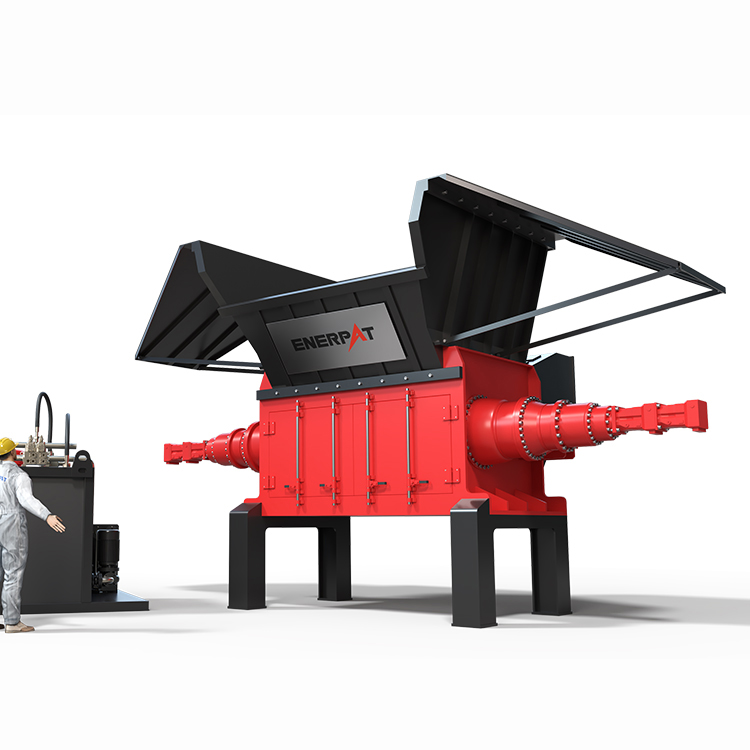
In contrast to the precision of single-rotor systems, a multi-shaft shredder is a heavy-duty size reduction machine built for raw power and aggressive volume reduction. Found primarily in double-shaft and quad-shaft configurations, these machines handle the toughest, most contaminated waste streams. Such materials would instantly destroy high-speed cutting equipment.
Instead of a single high-speed rotor, these machines utilize two or four counter-rotating shafts equipped with massive, interlocking hexagonal blades. The heavily armored shafts turn inward toward each other. The interlocking blades physically grab the material, piercing it, and dragging it down through the center of the machine.
This mechanical process relies entirely on a shearing and tearing action. The immense sheer force generated by the slow-moving interlocking blades is enough to rip apart thick metals, heavy rubber tires, and dense electronic waste. To keep operations smooth, multi-shaft shredders are equipped with cleaning fingers that scrape the material off the blades. This prevents flexible items like seatbelts or strapping from wrapping around the shafts and causing catastrophic jams.
Crucially, most double-shaft shredders operate without a sizing screen. The material passes through the interlocking blades in a single, violent pass. Consequently, the output consists of rough, variable sizes, typically long strips or irregular chunks. The primary goal here is simply to reduce the physical footprint of the waste, not to achieve particle uniformity.
High Torque, Low Speed: Operating at very low RPMs, typically 15 to 35 RPM, these machines generate immense mechanical torque. This allows them to crush extremely tough materials, such as passenger tires or metal 55-gallon drums, without stalling.
Aggressive Infeed: The inward rotation of the interlocking blades creates a natural self-feeding mechanism. The machine easily consumes large, hollow, or bulky items. It forcefully pulls them into the cutting zone without needing a hydraulic ram.
Low Dust and Noise: The shafts rotate very slowly. Therefore, the tearing action generates significantly less airborne dust and operates at a much lower decibel level compared to high-speed shredding technologies. This greatly improves facility safety and air quality.
Making an informed decision between these size reduction technologies requires a rigorous evaluation of how each machine operates under real-world industrial conditions. Buyers must look beyond the initial capital expenditure and analyze the mechanical capabilities. A direct, dimension-by-dimension comparison reveals distinct operational philosophies. Each is engineered to solve specific waste management challenges.
Feature / Metric | Single Shaft Shredders | Multi-Shaft Shredders |
|---|---|---|
Primary Action | Precision cutting and machining | Aggressive shearing and tearing |
Operating Speed | High speed, typically 60 to 120 RPM | Low speed, typically 15 to 35 RPM |
Torque Level | Moderate to High | Extremely High |
Output Consistency | Highly uniform, controlled by screen | Irregular strips or chunks, no screen |
Infeed Mechanism | Hydraulic pusher required | Self-feeding via interlocking blades |
Contaminant Tolerance | Low, metals can damage screens and knives | High, can process tramp metal easily |
The most critical distinction between these two technologies lies in their final output. A single shaft machine is explicitly engineered for precision. It utilizes a stationary sizing screen positioned directly beneath the high-speed spinning rotor. The material is continuously milled against the stationary bed knives. This closed-loop cutting chamber guarantees a highly predictable particle size, typically ranging from 10mm to 50mm. This fine, consistent flake is immediately ready for downstream processing.
Furthermore, multi-shaft shredders pull material through the blades just once. Without a sizing screen to hold the material back, the resulting output consists of coarse, irregular strips often ranging from 50mm to over 150mm. While highly effective for primary volume reduction, this lack of uniformity means the output usually requires secondary processing if a homogenous particle size is needed for remanufacturing.
Material physics dictate equipment selection. The high-speed milling action of a single shaft machine makes it the optimal choice for materials requiring precise shearing. It excels at processing rigid plastics, thick-walled PVC pipes, wood pallets, and Municipal Solid Waste. As long as the machine is properly calibrated, the clean cutting action prevents these materials from melting or wrapping around the rotor.
Conversely, multi-shaft shredders are the undisputed champions of heavily contaminated or highly elastic materials. The tearing action of counter-rotating shafts easily consumes scrap metal, hazardous waste drums, mattresses, and e-waste. Complex, hollow structures containing heavy steel components would severely damage the internal screen of a single-shaft machine. However, they are effortlessly crushed by the immense torque of a multi-shaft system.
Total Cost of Ownership is heavily influenced by how a machine is maintained. Single shaft shredders are generally designed with maintenance efficiency in mind. The rotor is equipped with small, indexable cutters. These are usually square-shaped knives manufactured from hardened tool steel. When one cutting edge becomes dull, a technician simply unscrews the cutter, rotates it 90 degrees to expose a sharp edge, and bolts it back into place. This keeps routine maintenance costs low and minimizes operational downtime.
Multi-shaft shredders require a completely different, much heavier maintenance approach. The interlocking cutting disks wear down much slower due to the low-speed operation. However, rebuilding them is a massive undertaking. It often requires dismantling the entire cutting chamber, using heavy lifting equipment to extract the shafts, and sending the blades out for professional hard-facing. Consequently, the financial and temporal cost of that maintenance is significantly higher.
Energy consumption profiles differ vastly due to operational speeds. Single shaft machines run at higher rotational speeds and utilize a combination of electrical energy and hydraulic power. This high-speed milling process requires continuous, high energy input to achieve fine size reduction in a single pass. The energy is spent on precision.
In practical terms, multi-shaft machines operate on the principle of High Torque, Low Speed. Instead of relying on speed and momentum, they use raw mechanical torque to rip materials apart. This low-speed operation is inherently more energy-efficient when the sole objective is primary volume reduction. It breaks down large items with deliberate, unstoppable force.
Selecting a single shaft machine is highly recommended when your operational workflow demands a specific, homogenous end-product in a single step. Your facility might operate downstream equipment such as injection molding machines, extruders, or high-speed granulators. These machines strictly require a small, uniform feed size to prevent jamming. In this scenario, this technology is the undisputed winner. The built-in sizing screen acts as a strict quality control checkpoint.
Specifically, this technology is vital for the plastics recycling industry. When processing highly dense materials like injection molding purgings or thick plastic lumps, the internal architecture provides a distinct advantage. The automated hydraulic ram continuously forces these smooth, dense objects against the high-speed rotor, ensuring a steady bite.
For facilities looking to maximize their throughput while handling tough, rigid industrial waste, investing in a robust Single Shaft Shredder provides the necessary combination of pushing force and high-speed shearing. This ensures that even the most stubborn solid plastics are efficiently reduced to uniform flakes. It optimizes the entire recycling line return on investment.
Objectively, there are numerous industrial scenarios where a single shaft machine would be highly inefficient or prone to catastrophic failure. A multi-shaft shredder becomes the necessary choice when your primary objective is strictly volume reduction or product destruction. Your facility might be tasked with destroying hard drives for data security, shredding end-of-life tires to meet landfill regulations, or crushing 55-gallon steel drums to save space in shipping containers. In these cases, particle uniformity is completely irrelevant.
In addition, material contamination is a critical deciding factor. Imagine trying to feed an entire engine block or a mattress full of heavy steel springs into a high-speed rotor. The heavy metals would instantly shatter the fast-moving knives and destroy the delicate sizing screen. The low-speed, high-torque nature of counter-rotating shafts allows the multi-shaft shredder to easily chew through these metals without suffering catastrophic blade failure or causing dangerous kickbacks.
Making a bottom-of-funnel purchasing decision requires moving beyond basic technical specifications. A systematic evaluation of throughput, spatial requirements, and long-term financial impact is essential. This maximizes operational efficiency in your specific facility.
Buyers must accurately calculate their required tons per hour and account for peak surge capacities. It is a common engineering mistake to purchase a shredder based solely on average daily volume. Your facility might receive waste in massive, intermittent bulk deliveries. The shredder must have a hopper and cutting chamber large enough to process those surges without causing a bottleneck. Additionally, remember that installing a smaller screen to get finer particles will inherently reduce the overall processing speed of the machine.
The physical layout of your facility will dictate the type of machinery you can install. Single shaft shredders, particularly those equipped with horizontal hydraulic rams, often require a larger horizontal footprint. This accommodates the extension and retraction mechanism of the pusher. Multi-shaft shredders typically utilize a gravity-fed design, dropping material straight down through the blades. This makes them taller but often requires less floor space. Always account for the space required for infeed conveyors, discharge belts, and safe maintenance access zones.
Evaluating financial viability requires looking far beyond the initial purchase price. Total Cost of Ownership is the only accurate metric for industrial equipment. Calculate the projected energy consumption and factor in local electricity rates. Furthermore, maintenance budgets must be rigorously forecasted. A high-quality Heavy-Duty Hydraulic Single Shaft Shredder may require more frequent screen cleanings and cutter rotations. However, the labor cost is relatively low and can be done in-house. Multi-shaft machines might run longer between services, but the eventual cost to rebuild the complex shafts can be a massive capital expenditure.
Choosing the right shredding equipment ultimately depends on the specific physics of your waste material and your target output size. Single shaft machines provide excellent precision. They utilize screens and hydraulic rams to deliver uniform sizing perfect for downstream recycling. Conversely, multi-shaft shredders deliver raw, unstoppable power for massive volume reduction and heavy contaminant processing.
We highly encourage facility managers to evaluate their waste streams carefully before purchasing equipment. By understanding these structural differences, you can accurately align your machinery investments with your production goals. Ready to upgrade your recycling line? Explore high-performance solutions from Enerpat and check our industrial specifications to find the perfect machine match that will optimize your daily operations for years to come.
While they possess robust cutting capabilities, they are generally only suited for occasional, soft metals like aluminum beverage cans, thin copper wires, or light tin packaging. They are strictly not designed for heavy scrap metal processing. Introducing heavy steel, iron, or thick metal components into the cutting chamber will cause severe damage to the high-speed rotor knives, bend the rotor shaft, and shatter the sizing screen. For processing heavy metals, a high-torque multi-shaft shredder is the absolute requirement.
In terms of routine, day-to-day maintenance, single shaft shredders are generally more cost-effective and easier to manage. They utilize small, indexable cutters. These square knives can be manually rotated up to four times to expose a fresh cutting edge before a full replacement is needed. In-house staff can do this quickly. Multi-shaft shredders require less frequent maintenance intervals. However, when the blades eventually wear down, rebuilding the complex hexagonal shafts and replacing the massive interlocking disks is highly labor-intensive. It often requires specialized technicians and significant operational downtime.
The necessity of a screen depends entirely on your downstream processing requirements. Your recycling line might demand a guaranteed, uniform particle size, such as consistent 40mm flakes to feed into a plastic extruder. If so, a screen is mandatory. This means you must select a single shaft shredder. However, your only objective might be to destroy a product for security purposes or to reduce the volume of bulky waste before sending it to a landfill. In that case, a uniform size is irrelevant, and no screen is necessary.
The hydraulic pusher, or ram, is a critical component for maintaining processing efficiency. Single shaft shredders rely on a fast-spinning rotor acting against a stationary bed knife. Bulky or highly dense materials, like large plastic lumps, might simply bounce around the hopper without being cut. The hydraulic pusher automatically and continuously forces the waste material directly against the spinning blades. This ensures a constant, aggressive bite, prevents material bridging in the hopper, and maximizes the overall throughput capacity of the machine.
Blade lifespan depends heavily on the abrasiveness of the material being processed and the operating hours. For single shaft machines processing standard plastics, the hardened steel indexable cutters can last several hundred hours per edge before needing rotation. Multi-shaft shredder blades are thicker and rotate slower, meaning they can often run for thousands of hours before requiring a full hard-facing rebuild. Routine inspection and removing tramp metal from the feed stream will significantly extend the life of any blade system.
Preventing jams requires a combination of proper machine selection and operational best practices. First, ensure you are not feeding heavy metals into a high-speed machine. Second, utilize a shredder equipped with a Programmable Logic Controller. The PLC monitors motor amperage and will automatically reverse the rotor or retract the hydraulic ram if it detects an overload. Finally, establishing a steady, controlled material feed rate rather than dump-loading massive batches will keep the cutting chamber operating at peak efficiency without stalling.


