


 English English
Views: 0 Author: Site Editor Publish Time: 2026-11-18 Origin: Site


Waste management facilities face a critical operational challenge daily. Selecting the right heavy-duty size reduction equipment maximizes processing efficiency and return on investment. Choosing the wrong machine leads to operational bottlenecks. It causes excessive maintenance downtime. Ultimately, it severely hurts the bottom line.
Both two-shaft and four-shaft shredders operate as powerful dual-shear machines. They are designed for significant volume reduction. However, their internal mechanical designs differ substantially. Output sizing capabilities and ideal material applications also vary. Many plant operators struggle with inconsistent output sizes. They simply misunderstand how these distinct machines handle material flow. This comprehensive guide provides an objective, technical comparison between standard twin-shaft models and advanced four-shaft systems. It helps facility managers make an informed, data-driven purchasing decision.
Output Size: Two-shaft shredders produce rough, variable-sized strips. Conversely, four-shaft models utilize an integrated sizing screen to guarantee a uniform, specific output size in a single pass.
Working Principle: Two-shaft machines rely on two counter-rotating shafts for standard shearing. A four-shaft system utilizes four distinct shafts for superior material grabbing and relentless processing power.
Ideal Applications: Two-shaft models are best suited for the primary shredding of bulky, solid waste. Four-shaft models excel at processing difficult, hollow, or high-volume materials where precise final sizing is non-negotiable.
Maintenance and Cost: Four-shaft machines require a higher initial capital investment and involve slightly more complex routine maintenance. However, they eliminate the need for downstream secondary shredders, offering excellent long-term financial returns and saving valuable factory floor space.
To specify equipment correctly, engineers must first understand the mechanical foundation of standard volume reduction machinery. A two-shaft shredder operates on a straightforward mechanical principle. The machine utilizes two parallel shafts equipped with interlocking cutting disks. These blades feature specialized hooks. The shafts counter-rotate at low speeds while generating exceptionally high torque.
As material enters the cutting chamber from the hopper, the opposing rotation grabs the waste. It pulls the material downward into the bite. The overlapping blades then shear, tear, and fracture the material apart. This high-torque mechanism breaks down tough items without generating excessive heat or dust. It remains a staple in many traditional recycling facilities.
Primary Function and Operational Goals
In a standard recycling line, the primary role of a two-shaft machine is rough volume reduction. Precise material sizing is not the goal here. Massive waste arrives at a facility and must be broken down into manageable pieces. Conveyor belts then transport these pieces to secondary processing equipment. The twin-shaft design achieves this by aggressively tearing materials into irregular fragments.
Common Industry Applications
Empirical data from recycling facilities shows exceptional effectiveness for solid materials. This includes mixed municipal solid waste before landfilling. It also covers pre-shredding whole passenger and commercial truck tires. Reducing large wooden structures like pallets optimizes transport logistics.
Mechanical Limitations
Despite their brute power, two-shaft shredders possess a significant mechanical limitation. They lack a sizing screen underneath the cutting chamber. There is no physical barrier to restrict the size of the exiting material. Consequently, the output geometry remains highly unpredictable. Long, narrow strips often slip through the cutting chamber without being fully reduced. Downstream sorting technologies like optical sorters require a strict, uniform particle size. A two-shaft machine alone simply will not suffice.
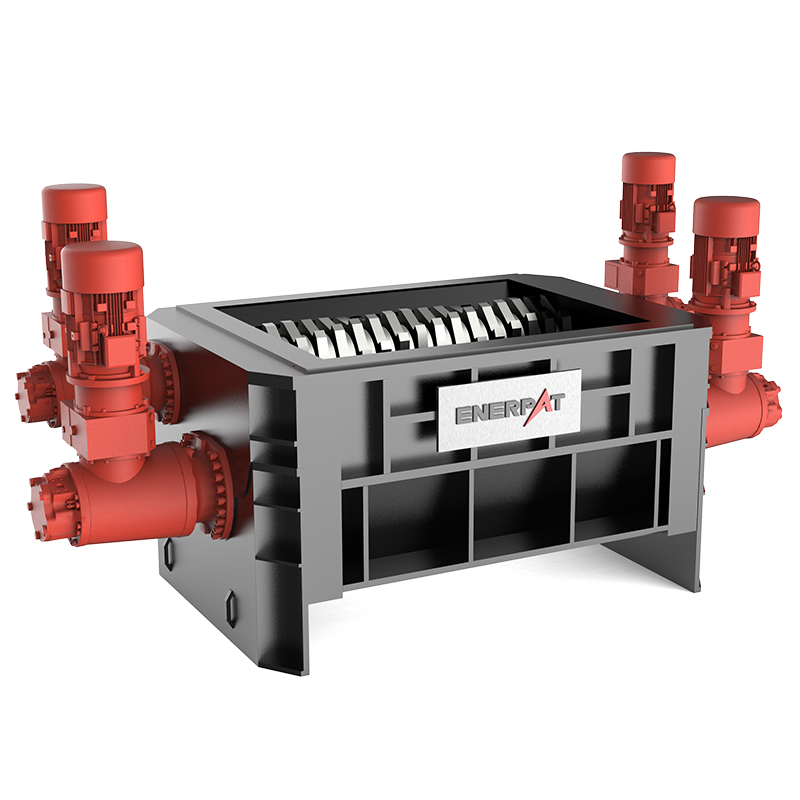
Facilities often require the high torque of a primary shredder combined with the precise sizing of a secondary granulator. The four-shaft design offers an advanced engineering solution for this exact scenario. This machine builds upon the dual-shear concept. It introduces a highly sophisticated cutting chamber geometry designed to conquer the limitations of twin-shaft models.
The configuration consists of four distinct shafts working in tandem. Two main cutting shafts lie at the bottom of the chamber. They perform the primary shearing action. Directly above these sit two auxiliary feeding shafts. These top shafts rotate to aggressively grab incoming material. They pre-cut the waste and forcefully drive it down into the main cutting shafts below. This active feeding mechanism practically eliminates the issue of bulky items bouncing on top of the blades.
The Power of the Integrated Screen
The most critical feature of this advanced design is the integrated sizing screen. It sits directly underneath the cutting chamber. In a standard two-shaft machine, material falls through to the discharge conveyor instantly. In contrast, a four-shaft system uses the screen as a strict gatekeeper.
If a shredded particle is small enough, it passes through the screen holes. If the particle is too large, the cutting hooks on the main shafts carry it back up. The auxiliary shafts then sweep this oversized material back into the center of the cutting zone. This continuous recirculation process repeats relentlessly. Every single piece of material eventually becomes small enough to pass through the screen.
Why It Stands Out in the Industry
This technology successfully bridges the gap between rough primary shredding and fine secondary granulation. Historically, achieving a uniform forty-millimeter particle size from a steel drum required a complex multi-machine setup. Today, integrating a specialized Four Shaft Shredder allows operators to achieve high-torque primary destruction and precise secondary sizing within a single pass. It perfectly combines heavy-duty resilience with strict accuracy.
Output predictability is often the deciding factor for plant managers when selecting equipment. To fully appreciate which machine aligns with specific operational needs, engineers must compare their core mechanical differences side-by-side. The engineering variations directly impact throughput, material handling capabilities, and the ultimate quality of the final recycled commodity.
Shaft Configuration and Grabbing Power
The number of shafts fundamentally changes how the machine interacts with difficult feedstocks. Twin-shaft machines exhibit excellent grabbing power for solid items that naturally sink into the cutting bite. However, from a practical standpoint, they frequently struggle with large, hollow, or lightweight bulky items. Picture a smooth plastic barrel entering a twin-shaft machine. It often surfs or bounces loudly on top of the rotating blades. Operators are then forced to use hydraulic rams to push the material down, severely bottlenecking throughput.
Furthermore, the addition of the two upper auxiliary shafts in a four-shaft model eliminates this bouncing problem entirely. The top shafts feature specialized hook profiles that actively bite into smooth or bulky materials. They fracture the items and forcefully feed them into the lower cutting shafts without hesitation. This active feeding mechanism drastically increases processing efficiency for challenging materials.
Output Consistency and Control
With a two-shaft machine, the output is unpredictable. It produces rough, strip-like fragments where the length is entirely uncontrolled. Conversely, the output from a four-shaft machine is highly uniform and strictly controlled by the screen. Operators can dictate the exact final size simply by swapping out the sizing screen beneath the cutting chamber.
Feature | Two-Shaft Shredder | Four-Shaft Shredder |
|---|---|---|
Shaft Count | 2 Main Shafts | 2 Main, 2 Auxiliary Shafts |
Sizing Screen | No | Yes Integrated |
Output Size | Irregular, long strips | Uniform, screen-determined |
Grabbing Power | Good for solid/heavy items | Excellent for hollow/bulky items |
Material Bouncing | High risk with hollow objects | Eliminated by top feeding shafts |
Process Type | Primary rough shredding | Primary and secondary in one pass |
While twin-shaft machines are excellent workhorses for general refuse, certain materials strictly demand specialized mechanics. Understanding these specific use cases easily justifies the investment in advanced shredding technology.
Electronic Waste Recycling
Waste electrical and electronic equipment recycling requires precise material liberation. Processing computers and household appliances aims to separate plastics, copper, aluminum, and precious metals. If the shredded pieces are too large, different materials remain physically attached. Downstream magnetic sorting becomes impossible. Deploying an industrial Four Shaft Shredder ensures that electronic waste is reduced to a specific uniform size. This guarantees that components like printed circuit boards are fully liberated.
Hazardous and Medical Waste
Processing hazardous materials involves strict regulatory compliance. Medical waste must be rendered completely unrecognizable. It must be destroyed to a specific particle size before legal sterilization. The integrated screen guarantees that no intact syringes or identifiable medical tools slip through the cutting chamber. This ensures absolute public safety.
Metal Drums and Industrial Containers
Industrial containers like fifty-five-gallon metal drums and plastic intermediate bulk containers are notoriously difficult to process. Their hollow, smooth cylindrical shapes prevent standard twin-shaft blades from getting a proper grip. Specifically, the upper auxiliary shafts easily puncture and crush these containers. They pull the metal directly into the main cutters, eliminating material bridging and maintaining a steady flow.
Confidential Document and Product Destruction
Guaranteed destruction is non-negotiable for secure data. A two-shaft machine might allow a long strip of a sensitive document to pass through. The screen-driven recirculation ensures sensitive items are repeatedly shredded until they meet strict security sizing standards. This leaves zero chance of data recovery or product reuse.
Analyzing the broader recycling landscape reveals a massive shift towards precision processing. Driven by the global transition to a circular economy, commodity buyers now demand higher purity rates for recycled plastics and metals. Rough, irregular shreds are no longer acceptable for premium market prices. Furthermore, stricter environmental regulations regarding electronic waste and secure data destruction force facilities to upgrade their capabilities.
Market reports indicate a growing preference for single-step reduction systems. Plant managers face rising industrial real estate costs. They are increasingly moving away from sprawling multi-machine setups. Multi-functional equipment that performs heavy-duty primary destruction and precise secondary sizing simultaneously is taking over. This trend drives the rapid adoption of four-shaft technologies across modern recycling infrastructure. Facilities investing in precise sizing equipment report significantly higher recovery rates of valuable metals and plastics.
Beyond mechanical capabilities, plant managers must carefully consider facility layout. Floor space is a premium asset in any industrial environment. Equipment footprint directly influences daily operational efficiency.
The Two-Step versus One-Step Process
Traditional recycling setups require a cumbersome two-step process to achieve a small uniform particle size. Operators install a two-shaft shredder for primary volume reduction. A long inclined conveyor belt then transports the rough shreds into a secondary single-shaft shredder for final sizing. This setup demands complex electrical integration and synchronized maintenance schedules.
By contrast, a four-shaft system accomplishes both stages within a single machine. The material enters as bulky waste and exits as a uniform finished product in one continuous step.
Optimizing Facility Footprint
Consolidating two processing stages drastically reduces the equipment footprint. It eliminates the need for extensive transition conveyor belts and transition hoppers. This space efficiency optimizes the factory floor. It leaves more room for material storage and forklift navigation. It ultimately creates a safer working environment for staff.
Procuring industrial recycling equipment requires a thorough analysis of the total cost of ownership. Raw performance is critical. However, understanding the financial implications of maintenance and energy consumption is vital for long-term profitability.
Initial Capital Investment
A four-shaft machine requires a higher upfront capital investment compared to a standard two-shaft model. The inclusion of four heavy-duty shafts and a more complex planetary gearbox system naturally contributes to a higher manufacturing cost. Buyers must weigh this initial expense against the operational savings generated over the machine lifespan.
Blade Maintenance and Replacement
Blade maintenance is the most significant ongoing operational expense. A twin-shaft machine has fewer blades to monitor or sharpen. Routine maintenance is generally faster. Because a four-shaft machine features double the shafts, maintenance inherently takes more time. However, industry-leading manufacturers utilize modular blade designs and hardfaced cutting edges. Quick-change screen systems also ease the maintenance burden. You are maintaining one consolidated machine instead of servicing two entirely separate shredders.
Energy Consumption and Long-Term Value
Energy efficiency plays a major role in operational costs. A four-shaft machine utilizes larger motors. It consumes more power than a single two-shaft machine. However, the correct comparison is not one-to-one. Achieving the same uniform output size requires running a two-shaft shredder and a secondary granulator simultaneously. Running one four-shaft machine actually consumes significantly less total electricity than powering two separate machines. The long-term financial return of a four-shaft system is highly favorable.
Selecting the correct shredding technology requires a systematic evaluation of specific operational parameters. Use the following engineering criteria to guide the decision-making process.
Evaluate the input material
Examine the physical characteristics of the waste stream. Solid, heavy materials like wood pallets suit a two-shaft machine perfectly. Hollow, lightweight, or bulky items like plastic barrels demand the active feeding mechanism of a four-shaft system. This prevents material bouncing.
Determine final product size requirements
This is often the definitive metric. Downstream processes like basic transport only require rough volume reduction. A two-shaft shredder is the most cost-effective choice here. Selling commodities that require a strict particle size demands a machine with a sizing screen. The four-shaft design is mandatory in these cases.
Analyze throughput demands
Consider the required tons per hour. Two-shaft shredders achieve massive throughput rates because material falls through the blades instantly. Four-shaft machines meticulously recirculate material until it passes through a screen. They may have a slightly lower throughput per hour for the exact same physical footprint. Engineers must size the motor and cutting chamber appropriately to meet capacity needs. For instance, high-performance models feature dual drive motors ranging from sixty to one hundred and fifty kilowatts to maintain high throughput even with a restrictive screen.
Assess available floor space
Review the facility layout. Ample space allows for a multi-machine setup. Restricted floor space requires consolidating the process into a single-pass machine. The four-shaft system is the most logical engineering solution for compact areas.
Two-shaft and four-shaft shredders serve distinct processing needs within the recycling industry. Two-shaft models offer unparalleled rough volume reduction. They handle solid waste materials with ease and lower initial costs. On the other hand, four-shaft machines represent the pinnacle of precision processing. They provide uniform sizing in a single step while effortlessly digesting hollow materials.
Choosing the right technology prevents operational bottlenecks. It lowers long-term maintenance costs significantly. Proper equipment selection ultimately improves recycled material quality. This allows facilities to command higher prices for commodities. Evaluate specific material needs carefully today. Explore the capabilities of a high-performance Four Shaft Shredder to optimize the processing line. Visit Enerpat Shredders to find the exact equipment match for your facility. Contact their specialized engineering team for a custom quote to ensure your plant operates at peak efficiency.
Yes, a heavy-duty four-shaft machine is highly capable of processing light scrap metal, aluminum profiles, metal drums, and electronic waste. This is provided the machine is equipped with the correct blade metallurgy and sufficient motor torque to handle the shear strength of the specific metals being fed into the chamber.
Two-shaft shredders are designed strictly for rough volume reduction. They would quickly clog or jam if a screen were added directly below the cutters. A four-shaft machine uses its top two auxiliary shafts to constantly sweep and re-feed oversized materials back into the main cutters. This active mechanical recirculation prevents the screen from blinding or clogging, allowing for precise sizing.
Because it has double the shafts and more cutting blades, the individual machine maintenance is higher than a single twin-shaft model. However, because it often replaces the need for an entire two-machine setup, the overall system maintenance costs, energy bills, and labor hours are frequently much lower.
Output sizes are highly customizable based on the specific sizing screen installed beneath the cutting chamber. Typically, operators can expect to produce uniform controlled particles ranging from thirty millimeters to one hundred millimeters. This depends entirely on the material characteristics and the chosen screen hole configuration.
Blade lifespan depends heavily on the input material and the blade metallurgy. Processing clean plastics yields a much longer lifespan than processing abrasive electronic waste or scrap metal. High-quality blades made from specialized tool steel generally last several thousand hours before requiring sharpening or hardfacing replacement.
No, dual-shear shredders are not designed for solid, thick steel blocks or heavy plate metal. They are engineered for volume reduction of hollow, bulky, or light-to-medium gauge metals. Feeding solid steel blocks will trigger the machine overload protection system and can cause catastrophic damage to the cutting blades and gearboxes.


