


 English English
Views: 0 Author: Site Editor Publish Time: 2026-11-18 Origin: Site


Industrial recycling does not just wear machinery down; it actively tries to tear it apart. When you push three tons of vulcanized rubber or extruded aluminum through a cutting chamber every hour, the sheer stress exposes any design flaw immediately. Standard blades snap. Gearboxes fail. I have seen processing lines shut down for days simply because a rogue steel billet jammed a weak rotor. For plant operators, processing abrasive and bulky waste is a daily war against mechanical degradation and exorbitant downtime costs. You need equipment that fights back.
Modern facility managers demand heavy-duty equipment capable of enduring extreme operational stress while consistently delivering a predictable, uniform output. A highly engineered Four Shaft Shredder serves as the definitive answer to this exact bottleneck. By integrating a synchronized multi-rotor shearing mechanism with intelligent overload protections, this machinery completely redefines longevity in solid waste processing.
Looking at current industry trajectories, we are witnessing a massive pivot toward single-pass reduction systems. Driven by surging electricity costs and strict zero-waste-to-landfill mandates, facility managers are rapidly abandoning multi-stage crushing lines. The market now demands a single machine that can fracture bulky waste and deliver a fixed particle size simultaneously. This industry-wide shift heavily favors multi-shaft configurations equipped with sizing screens, as they drastically lower the plant's overall carbon footprint and electrical overhead.
The following sections dissect the core mechanical features that maximize the operational lifespan of these robust systems. We will explore exactly how they operate, the advanced engineering safeguarding their critical components, and why they represent a vital capital investment for long-term profitability.
Unmatched Durability: Industrial recycling environments require machinery that actively resists rapid mechanical degradation. Multi-shaft shredders utilize a highly engineered low-speed, high-torque mechanism paired with premium construction materials to endure extreme wear over extended periods.
Uniform Particle Sizing: Unlike standard dual-shaft models that primarily focus on crude volume reduction, four-shaft configurations incorporate a built-in sizing screen. This critical addition guarantees consistent, predictable output dimensions in a single operational pass.
Advanced Protection Systems: Catastrophic machine failures are effectively mitigated through integrated smart controls. Programmable Logic Controllers, instantaneous auto-reverse mechanisms, and completely isolated bearing housings work synergistically to prevent jamming and mechanical overload.
Versatile Applications: These robust systems are specifically engineered to process complex materials. They efficiently handle electronic waste, bulky municipal solid waste, hazardous chemical containers, and abrasive scrap metals without compromising structural integrity.
Long-Term Return on Investment: While the initial capital expenditure for a comprehensive system may be higher, the extended lifespan of the cutting blades and the significantly reduced maintenance downtime yield a highly favorable total cost of ownership.
Before diving into specific durability features, recycling managers must understand the baseline mechanics dictating the equipment's performance. The structural configuration of a multi-rotor system defines exactly how it processes dense, unyielding materials without succumbing to structural fatigue.
The operational efficiency of this machinery relies on a synchronized, multi-rotor architecture. The primary cutting chamber houses four distinct, parallel rotors: two main cutting shafts and two auxiliary sweeper shafts. Operating in perfect tandem, these components aggressively break down input materials through a continuous, methodical shearing action.
Positioned geographically higher than the primary rotors, the auxiliary sweeper shafts perform a crucial function. They actively grip bulky, oddly shaped, or highly elastic materials, forcefully directing them down into the primary cutting zone. This continuous downward feeding mechanism actively prevents material bridging. Bridging is a frustrating scenario where waste forms a rigid arch over the blades, effectively starving the machine and halting production. By constantly sweeping material into the cutters, the machine maintains a steady processing flow. This steady flow subsequently prevents sudden, damaging stress spikes on the drive motors.
Facility operators frequently debate whether a dual-shaft or four-shaft configuration better suits their processing line. Dual-shaft shredders certainly excel at primary volume reduction and pre-crushing. However, they fundamentally lack the mechanical architecture required to precisely control the final particle size. When a facility demands both extreme mechanical durability and a specific, highly uniform output dimension, upgrading to a four-shaft system becomes an operational necessity.
Feature Comparison | Dual-Shaft Shredder | Four-Shaft Shredder |
|---|---|---|
Rotor Configuration | Operates with only two primary cutting shafts. | Features two primary cutters plus two auxiliary sweeper shafts. |
Particle Sizing | Produces random, strip-like output; lacks precise size control. | Delivers a highly uniform, strictly controlled final particle size. |
Screen Integration | Cannot physically accommodate a sizing screen beneath the rotors. | Incorporates a built-in sizing screen directly beneath the cutting chamber. |
Material Bridging | Highly prone to bridging when processing hollow or bulky items. | Auxiliary shafts actively agitate material to prevent bridging. |
Primary Application | Best suited for initial volume reduction and primary breakdown. | Ideal for single-pass size reduction and secure material destruction. |
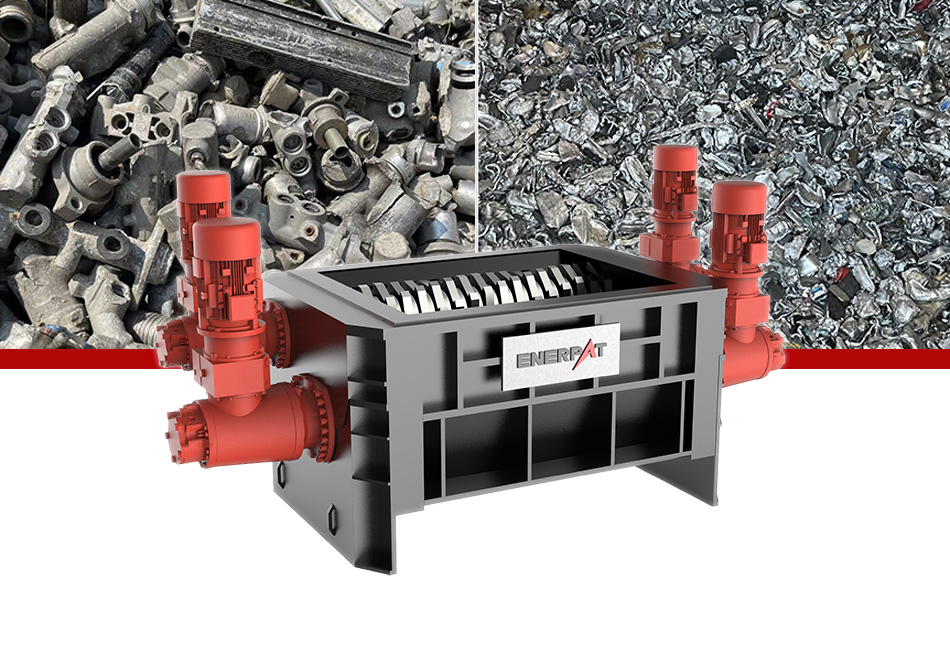
Machine ruggedness in the heavy recycling sector is never an accident. It is the direct consequence of applied material science, precise machining, and deliberate mechanical design meant to withstand punishing realities.
The cutting blades dictate a machine's fundamental ability to process abrasive waste consistently. Take the ENERPAT MSC-E1900 Four-Shaft Aluminium Shredder as a prime example of industrial-grade engineering. It utilizes high-alloy, heat-treated steel for its cutting hooks and spacers. Enhanced through advanced surface hardening processes, this specific metallurgical composition offers exceptional resistance to surface abrasion, micro-chipping, and deformation. This holds true even when tearing through thick-walled plastics or rigid aluminum profiles.
In practice, the interlocking blade geometry across the parallel rotors maximizes the applied shearing force while carefully minimizing the physical strain placed on any single component. By trapping the material between opposing edges, the blades efficiently fracture tough waste streams. Distributing this heavy cutting load across multiple contact points actively prevents premature metal fatigue. To further bolster durability, premium models utilize hexagonal or splined shaft designs rather than standard keyways. This engineering choice virtually eliminates the risk of blades shearing off the shaft under extreme rotational torque.
In the heavy machinery sector, bearings are widely recognized as the Achilles heel of shredding equipment. Imagine fine glass dust, corrosive chemical leachate, or abrasive metal shavings seeping into a bearing housing. Within hours, the resulting friction destroys the rolling elements, halting a million-dollar production line.
To effectively counter this vulnerability, high-quality machines feature a completely isolated bearing housing design. The bearings are physically separated from the main cutting chamber by a distinct spatial gap. This structural isolation is reinforced with multi-layered labyrinth seals and specialized mechanical packing. Consequently, environmental contaminants cannot reach the sensitive rolling elements. Protecting the bearings in this comprehensive manner drastically extends the machine's overall lifecycle and significantly reduces the frequency of expensive gearbox rebuilds.
The fundamental physics of shredder longevity rely heavily on a low-speed, high-torque operational model. Operating at lower rotational speeds—typically ranging between 15 and 35 revolutions per minute—significantly reduces the kinetic friction generated during the cutting process. Less friction inherently means less heat generation. Keeping temperatures low preserves the temper, hardness, and sharp profile of the steel cutting blades.
Simultaneously, the immense high-torque output provides the rotational force required to power through dense, unyielding materials. Whether the machine is processing solid aluminum engine blocks, thick rubber truck tires, or dense bales of textile waste, the drive prevents the rotors from stalling. This continuous, methodical shearing action completely avoids the violent mechanical shocks and vibrations associated with high-speed impact crushers, thereby preserving the structural integrity of the heavy steel main frame.
Equipment that can simultaneously fracture bulky waste and guarantee a fixed particle size is now the gold standard. The inclusion of a sizing screen is the defining structural characteristic that makes single-pass reduction possible.
Positioned directly beneath the primary cutting rotors, the sizing screen acts as a strict physical gatekeeper for the output material. As the shafts pull waste down and shear it, the fragmented pieces fall toward the screen. If a particle is small enough to pass through the precise perforations, it exits the machine as a finished, uniform product. If a piece remains too large, the auxiliary sweeper shafts grab the oversized fragment and continuously recirculate it back into the primary cutting zone for further reduction.
This closed-loop recirculation guarantees unparalleled output consistency. From a facility engineering perspective, achieving the target dimension in a single pass entirely eliminates the need for secondary granulators. Reducing the total number of machines required on the processing line inherently decreases overall equipment wear, lowers energy consumption, and simplifies facility-wide maintenance scheduling.
Because the sizing screen constantly interacts with sharp, heavy, and abrasive material fragments under high downward pressure, it must be constructed from thick, highly wear-resistant steel plates like Hardox. The screen's geometry and mounting points are precisely calculated to withstand immense force without warping or cracking.
Recognizing that operators frequently transition between different materials and size specifications, manufacturers prioritize user-friendly replacement mechanisms. Modern machines feature modular screen cradles and hydraulic access doors. These innovations allow maintenance teams to quickly swap out screens, minimizing machine downtime and keeping production schedules strictly on track.
Mechanical ruggedness must be paired with intelligent software monitoring to achieve maximum operational durability. Advanced electrical sensors actively protect the mechanical hardware from operator error, power fluctuations, and unprocessable rogue materials.
Even in highly sorted waste streams, unshreddable objects like solid steel billets or dense forklift parts can accidentally enter the cutting chamber. When the machine encounters an object exceeding its maximum designed cutting capacity, the drive system experiences a sudden, extreme spike in torque.
Smart control systems instantly detect this overload via amperage sensors. Within milliseconds, before the mechanical strain can snap a cutting blade or severely damage the planetary gearbox, the PLC triggers an automatic reversal process. The shafts immediately stop their forward motion, reverse their rotation to clear the obstruction, and then resume forward operation. If the jam persists after a preset number of automated reversal attempts, the machine safely shuts down completely and triggers an audible alert. This automated self-protection mechanism is absolutely vital for preventing catastrophic hardware failures.
Programmable Logic Controllers serve as the central digital nervous system of modern industrial shredders. These advanced control panels continuously monitor the real-time health, efficiency, and operational metrics of the equipment without requiring constant human oversight.
The control system tracks critical data points, including motor operating temperatures, hydraulic fluid pressure, and electrical load balancing across the primary drive motors. By continuously analyzing this data, the system issues automated alerts for upcoming preventative maintenance intervals. This proactive approach allows facility managers to address minor issues—such as a slight increase in bearing temperature—before they escalate into costly downtime events that disrupt the entire recycling operation.
The robust engineering of these machines translates directly into versatile, real-world industrial applications. By examining specific use cases, facility operators can better align the equipment's technical capabilities with their exact waste stream requirements.
Processing electronic waste requires specialized equipment capable of handling a volatile mix of rigid plastics, thick copper wiring, and hard metals without generating excessive dust or friction-induced sparks. The four-shaft configuration excels in safely destroying hard drives, heavy circuit boards, and obsolete consumer electronics. Its low-speed operation minimizes the risk of thermal events and spontaneous combustion, making it highly suitable for hazardous waste applications where strict environmental containment is paramount.
Heavy-duty recycling applications demand uncompromising durability. When processing end-of-life vehicle tires, the machine must cut through tough vulcanized rubber and high-tensile steel wire simultaneously without stalling. The interlocking blades of specialized machinery, such as a four shaft shredder for aluminium, are engineered precisely to handle highly abrasive, mixed-material inputs. Similarly, for light scrap metal, rigid aluminum profiles, and bulky municipal solid waste, the multi-rotor design aggressively fractures the material while the sizing screen ensures a dense, transport-ready final product.
Protecting a significant capital investment requires strict, uncompromising adherence to preventative maintenance protocols. While inherently durable by design, routine and systematic care is essential to sustain the machine's high-performance baseline over a decade or more of continuous use.
The cutting blades bear the absolute brunt of the physical work and require consistent, documented monitoring. Facility operators should implement a standardized inspection checklist to evaluate blade wear on a weekly basis. Maintenance personnel must check for micro-fractures, evaluate the sharpness of the primary cutting edges, and measure the clearance gap between opposing rotors.
As blades naturally wear down, shearing efficiency drops, forcing the drive motors to consume more electricity. Implementing a hard-facing maintenance schedule—where specialized, highly durable weld material is applied to the worn blade edges to restore their original profile—can significantly extend the time between full blade replacements. This engineering practice directly optimizes operational budgets.
High-torque drive mechanisms rely entirely on proper, consistent lubrication to function without excessive friction. Maintenance teams must strictly adhere to the manufacturer's recommended greasing intervals for all isolated bearing housings, utilizing the specific grade of industrial lubricant required for high-load applications.
From a maintenance perspective, gearbox oil levels and quality must be checked regularly. Contaminated or degraded gear oil quickly leads to overheating and accelerated gear tooth wear. Routine visual inspections of the hydraulic systems for micro-leaks, checking drive belt tension, and verifying sensor calibrations ensure that the overload protection systems will trigger exactly when required.
The physical engineering and advanced software systems driving machine durability ultimately depend on the expertise of the manufacturer. Industrial recycling is highly variable. Therefore, selecting a supplier equipped to tailor machinery to specific operational demands is just as critical as understanding the mechanical features.
A standardized machine often falls short when processing complex materials. Buyers should seek manufacturers offering extensive customization options. The geometry of the cutting blades must be optimized for the specific waste stream, with options for different hook numbers, thicknesses, and metallurgical compositions to maximize shear strength.
Furthermore, the sizing screen must be customizable. Operators need the ability to select specific screen hole diameters and geometries to achieve the exact uniform particle size required. Hopper designs also require tailoring based on the facility's feeding method to ensure a steady feed rate into the cutting chamber. Investing in a properly configured industrial Four Shaft Shredder aligns the physical architecture directly with daily throughput targets.
In the heavy-duty recycling industry, equipment downtime translates directly to lost revenue. Consequently, machine durability must be backed by comprehensive warranties covering critical components such as gearboxes, motors, and rotor shafts. A manufacturer confident in their engineering will typically offer extended warranties on these high-stress parts.
Beyond the warranty, the availability of spare parts is a vital consideration. Buyers should ensure the manufacturer maintains a well-stocked inventory of wear parts and guarantees rapid shipping. Top-tier manufacturers provide remote diagnostic support, allowing engineers to securely connect to the machine's control panel via the internet to troubleshoot faults and optimize performance parameters without requiring an immediate on-site visit.
To make an informed purchasing decision, buyers must compare core technical metrics. The structural integrity of the machine can often be deduced from the following framework:
Evaluation Criteria | Standard Duty Requirement | Heavy-Duty Industrial Requirement | Impact on Machine Durability |
|---|---|---|---|
Machine Weight | Lighter frame, thinner steel | Massive steel construction exceeding 10 tons | Absorbs extreme vibrations and prevents structural fatigue over time. |
Shaft Diameter | Smaller diameter, prone to flexing | Large diameter, heat-treated alloy steel | Prevents shaft deflection and snapping when processing solid or dense materials. |
Bearing Housing | Integrated into the cutting chamber | Completely isolated from the cutting chamber | Prevents abrasive dust and liquid ingress, extending bearing life exponentially. |
Drive System | Single motor driving all shafts | Dual or independent premium motors with planetary gearboxes | Distributes torque evenly, reducing mechanical stress on a single power source. |
Blade Metallurgy | Standard carbon steel | High-alloy tool steel with custom heat treatment | Resists chipping and edge degradation, extending intervals between blade changes. |
Before finalizing a capital investment, operators should require material testing. Leading manufacturers maintain dedicated testing facilities where prospective buyers can send samples of their specific waste materials. Receiving video evidence, output samples, and detailed reports on throughput rates eliminates guesswork and proves the equipment's capability. Requesting case studies from existing clients operating in similar industries further verifies long-term reliability in real-world conditions.
The uncompromising durability of a four-shaft shredding system stems directly from its heavy-duty blade architecture, low-speed and high-torque drive mechanisms, isolated bearing protection, and intelligent overload software. Industrial recycling environments are undeniably brutal for standard machinery, but these highly engineered systems are purpose-built to thrive under extreme stress.
Investing in a well-designed multi-rotor shredder ensures continuous daily operation, guarantees a uniform output particle size, and ultimately delivers a highly profitable return on investment. Stop letting equipment bottlenecks dictate your production schedule. If your current shredding line is suffering from excessive downtime or inconsistent output, it is time for a heavy-duty upgrade. Visit Enerpat Shredders to explore systems like the MSC-E1900, and consult with our engineering team to custom-build a solution that seamlessly integrates into your facility's rigorous demands.
The primary advantage is the ability to produce a controlled, uniform particle size in a single pass. While dual shaft shredders excel at basic volume reduction by cutting material into long strips, they lack a sizing screen. A four-shaft system utilizes two main cutting shafts and two auxiliary sweeper shafts that continuously recirculate the material within the cutting chamber. The material only exits the machine once it is small enough to pass through the integrated screen below the rotors. This eliminates the need for secondary shredding equipment, streamlines the recycling process, and provides exceptional durability even when processing bulky materials.
A single shaft shredder uses a single high-speed rotor equipped with cutting blocks that push material against a stationary bed knife, aided by a hydraulic pusher. It is excellent for uniform sizing of lighter materials like plastics and wood. In contrast, a four shaft shredder uses four interlocking, low-speed, high-torque rotors to aggressively grab, shear, and tear bulky, dense, or hollow materials. The four-shaft design is far superior for processing complex, abrasive waste streams like tires, e-waste, and light metals without stalling or suffering severe blade damage.
These machines are engineered for extreme versatility and can process a wide array of challenging solid wastes. Common applications include electronic waste such as hard drives and computer towers, hazardous waste containers, passenger and commercial tires, bulky municipal solid waste, industrial plastics, and light scrap metal like aluminum extrusions and steel drums. The low-speed, high-torque shearing action is particularly effective at breaking down composite materials and items containing hidden metal inclusions without generating excessive sparks or dust.
Blade replacement frequency is highly variable and depends entirely on the abrasiveness of the material being processed and the daily operating hours. Processing relatively soft materials like plastics or paper may allow blades to last for thousands of hours. Conversely, shredding highly abrasive materials like tires containing steel wire or heavy scrap metal will accelerate wear. However, robust design features significantly extend blade life. Operators can often utilize hard-facing welding techniques to rebuild worn blade edges, delaying the need for a full replacement and lowering maintenance costs.
While all heavy industrial machinery requires routine maintenance to function safely and efficiently, these shredders are specifically designed to make maintenance manageable and less frequent. High-end models feature isolated bearing housings that protect sensitive components from contamination, drastically reducing bearing failures. Smart control systems monitor fluid levels and temperatures, alerting operators before catastrophic failures occur. Routine maintenance primarily involves scheduled visual inspections, regular lubrication of bearings and gearboxes, and periodic screen clearing.
The auto-reverse function is a critical software-driven safety mechanism designed to protect the mechanical and electrical components from severe damage. When the shredder encounters an unshreddable object or experiences a material jam, the control system detects an immediate spike in motor amperage and torque resistance. Within milliseconds, the system automatically halts the rotation of the shafts. It then reverses the shafts to clear the obstruction, and attempts to feed the material forward again. If the jam persists after several automated attempts, the machine shuts down completely and triggers an alarm, preventing motor burnout and shattered blades.
The sizing screen directly dictates both the final particle size and the overall throughput rate of the machine. A screen with smaller hole diameters will produce a finer, more uniform output, but it requires the material to recirculate through the cutting shafts multiple times before exiting. This extended residence time naturally reduces the tons-per-hour throughput. Conversely, a screen with larger holes allows material to pass through more quickly, increasing throughput at the expense of a larger particle size. Facility managers must work with manufacturers to select a screen geometry that perfectly balances their output size requirements with their daily capacity goals.
Yes, these machines are specifically designed to handle complex waste streams that contain hidden or embedded metal inclusions. The high-torque, low-speed operation allows the high-alloy steel blades to shear through aluminum, copper wiring, and light steel components without the violent impacts associated with high-speed granulators. This makes them ideal for e-waste and tire recycling. However, operators should note that while the machine can easily fracture light to medium metals, large solid steel blocks or heavy steel plates are generally considered unshreddable and will trigger the machine's automated overload protection system.
Despite their massive physical size and destructive power, these shredders are relatively energy-efficient compared to high-speed size reduction equipment. Because they operate on a low-speed, high-torque principle, they utilize mechanical leverage and gear reduction rather than relying on high-RPM kinetic energy. This design minimizes energy spikes and reduces the overall kilowatt-hour consumption per ton of material processed. The precise energy consumption will depend on the installed motor power and the density of the specific waste stream being shredded.
Choosing the correct motor size requires a careful analysis of your material's density, shear strength, and your facility's required throughput. Processing light plastics or paper requires significantly less torque, allowing for a smaller, more economical motor configuration. However, processing dense materials like scrap metal, thick-walled pipes, or heavy rubber tires requires maximum shearing force to prevent stalling. In these heavy-duty scenarios, buyers must opt for high-horsepower motors paired with robust planetary gearboxes. Consulting with the manufacturer's engineering team and conducting material tests is the most reliable way to determine the optimal drive system.
A four-shaft shredder improves return on investment by consolidating two processing steps into one. Because it features a built-in sizing screen, you eliminate the need to purchase, power, and maintain a secondary granulator. Furthermore, the low-speed, high-torque design experiences significantly less wear and tear than high-speed alternatives, meaning your replacement part costs plummet. By maximizing uptime, reducing energy consumption, and delivering a consistent, high-value shredded product ready for immediate sale or downstream sorting, the equipment pays for itself far quicker than traditional multi-machine setups.
Given the extreme forces involved in industrial shredding, safety features are non-negotiable. Standard safety equipment should include multiple, easily accessible emergency stop buttons located around the machine's perimeter and on the main control panel. The hopper design should feature extended walls or baffle curtains to prevent material from being ejected backward during operation. Furthermore, the machine should be equipped with zero-speed switches and interlock sensors on all access doors and maintenance panels, ensuring the rotors cannot be engaged while an operator is performing internal inspections or changing the sizing screen.


