


 English English
Views: 0 Author: Site Editor Publish Time: 2026-11-18 Origin: Site


If you walk through any modern material recovery facility today, the pressure to cut waste disposal costs is palpable. Plant managers are looking at skyrocketing landfill tipping fees and volatile raw material prices. Recent industry data indicates a massive pivot toward localized material processing. Instead of paying third-party contractors to haul away scrap, manufacturers are integrating in-house recycling lines to reclaim their own production waste. Environmental compliance is getting stricter, and circular economy models are no longer just corporate buzzwords—they are essential survival strategies for industrial operations.
Despite this clear financial incentive, selecting the right size-reduction equipment remains a minefield. The market is flooded with various crushers, granulators, and shearers. When you stand on the factory floor looking at a mountain of rejected plastic lumps or thick timber offcuts, picking the wrong machine will inevitably bottleneck your entire production. A mismatched rotor design or inadequate drive system leads to endless jamming, burned-out motors, and maintenance bills that destroy your return on investment.
To cut through the sales noise, we need to look at the equipment from an engineering perspective. This guide breaks down the single rotor shredding system as a precision-driven solution built for specific, heavy-duty tasks. We will strip away the marketing jargon to examine the actual mechanics, compare its shearing action to other common machines, and give you hard, objective criteria to decide if this is the right iron for your plant floor.
Precision Sizing: Built-in interchangeable screens guarantee a strict, predictable output dimension, making this the go-to choice before feeding granulators or extruders.
Core Mechanics: The system relies on a high-torque motorized rotor fitted with indexable cutting knives, paired with an intelligent hydraulic pusher that feeds bulky material into the cutting path.
Ideal Materials: Engineered specifically for thick, solid, and rigid waste streams like heavy plastic purges, timber blocks, paper rolls, and dense textiles.
Versus Double Shaft: Twin-shaft machines rip and tear without size control. Single rotor machines cut and mill against a fixed stator, providing exact sizing for highly rigid materials.
Maintenance Reality: Routine blade rotation, maintaining exact stator clearances, and hydraulic fluid checks are mandatory to prevent catastrophic gearbox failures and maintain tons-per-hour throughput.
At the most fundamental level, an industrial Single Shaft Shredder is a heavy-duty reduction machine featuring one horizontally mounted rotating cylinder covered in hardened steel knives. Think of it as a massive motorized milling cutter. It is designed to shave, chip, and slice solid blocks of waste that would instantly stall a standard high-speed granulator. The machine breaks down massive, bulky materials into manageable, uniform pieces in a single continuous pass.
The primary engineering goal here is exact volumetric reduction. By forcing the material through a specialized curved screen beneath the rotor, the machine ensures the output pieces meet specific dimensional tolerances, typically ranging from 10mm to 50mm. In facility design, this equipment sits at the critical transition point. You deploy this machinery when you absolutely need a consistent feed size for secondary processing equipment like briquette presses or plastic washing lines, ensuring your downstream workflow never starves or jams.
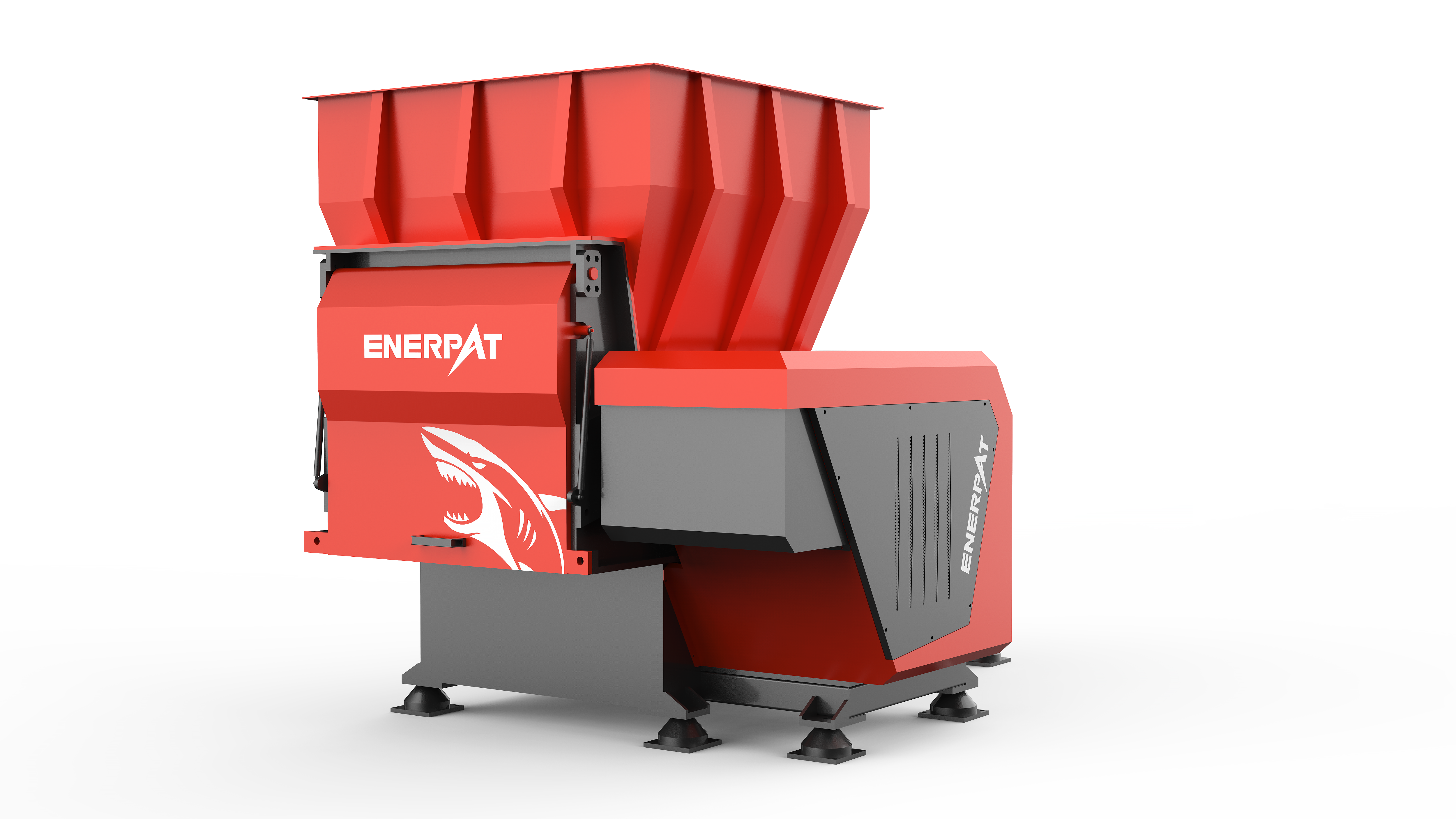
To truly understand how this machine achieves such reliable throughput, you have to look under the hood. The difference between a machine that runs 24/7 and one that breaks down weekly lies in the build quality of four synchronized components.
The solid steel rotor is the beating heart of the operation. Industrial-grade rotors often measure up to 400mm in diameter and are machined from solid billets. They are fitted with multiple rotary knives, generally forged from high-wear tool steel like D2 or DC53. These knives feature a square, concave profile, meaning they are indexable. When one edge dulls from chewing through abrasive plastics, a technician simply unbolts the knife, rotates it 90 degrees to a fresh edge, and locks it down. The rotor blades slice tightly against fixed stationary knives mounted to the frame. Maintaining a gap of just 0.2mm between these blades is what delivers a clean, energy-efficient cut.
Unlike twin-shaft units that let gravity pull material downward, a single smooth rotor cannot easily grab onto a flat, solid block of plastic. The solution is a heavy-duty hydraulic ram inside the cutting chamber. This pusher forces the waste horizontally into the spinning rotor. Advanced units utilize PLC-controlled load-sensing hydraulics. If the main motor approaches its maximum amperage limit, the ram automatically retracts a few inches. This intelligent feedback loop prevents motor stalls and eliminates the need for an operator to manually clear jammed blocks.
This component elevates the machine from a simple destroyer to a precision sizing tool. Mounted directly under the rotor, the heavy-duty steel screen acts as the strict gatekeeper. As the knives shave the material, particles fall toward the perforations. If a piece is small enough, it drops through. If it is too large, the rotor carries it back up for another round of slicing. This physical barrier outright guarantees your final output size.
Driving this violent process requires serious power. These machines use industrial electric motors ranging from 22kW up to 160kW or more, coupled with oversized reduction gearboxes. The system converts high-speed motor rotation into massive low-speed torque, usually turning the rotor between 60 and 120 RPM. This deliberate speed provides the crushing shear force needed to slice cleanly through solid timber or plastic purges without generating excessive friction heat.
In practice, the operational workflow is highly automated and heavily monitored by the internal control panel. Here is exactly what happens when a forklift dumps a load of waste into the hopper.
The cycle starts at the oversized infeed hopper. Depending on the plant layout, material arrives via an automated inclined conveyor or direct bin dumping. The hopper acts as a physical buffer zone, safely containing the chaotic, bulky material and directing it downward into the main cutting chamber.
Once the material lands in front of the rotor, the hydraulic ram activates. The control system continuously reads the main motor's current draw. Based on real-time resistance, it dynamically adjusts the ram's pushing pressure and speed. This keeps heavy, dense lumps pressed firmly against the cutting edges while preventing lightweight items from just bouncing around harmlessly.
Trapped between the advancing ram and the spinning rotor, the waste meets the rotary blades. The material is sliced against the fixed stator blades in a scissor-like action. Because the rotor spins relatively slowly, it chips and shaves the solid blocks rather than shattering them with blunt force, which drastically reduces dust generation.
Gravity pulls the newly cut fragments down to the sizing screen. Material that meets the dimensional tolerance falls seamlessly through the holes. These uniform pieces then drop onto an outfeed conveyor belt or get sucked into a pneumatic extraction pipe, perfectly prepped for the next recycling phase.
Beyond the impressive mechanical engineering, plant managers must evaluate the financial return on investment. Integrating an industrial single shaft shredding machine into your line delivers hard operational benefits that directly protect your bottom line.
Because the output is dictated by a fixed steel screen, the particle size is remarkably consistent. If you are feeding an extruder to make recycled plastic pellets, uniform feed material is absolutely critical. Irregular chunks will bridge in the feed hopper, starve the extruder screw, and cause massive drops in production. Precision sizing eliminates this bottleneck entirely.
A well-calibrated machine can handle wildly different waste streams. By simply swapping the screen size or adjusting the ram pressure, operators can transition from processing thick-walled PVC pipes to dense hardwood pallets, and then over to tightly wound paper rolls. This flexibility allows recycling centers to adapt quickly to whatever scrap materials are currently profitable on the market.
High-speed granulators spinning at 500 RPM sound like jet engines and create hazardous clouds of micro-dust. In contrast, the low-speed, high-torque cutting action of this equipment minimizes catastrophic material shattering. This drastically lowers ambient noise levels on the factory floor and keeps airborne particulates to a minimum, ensuring better compliance with occupational health and safety regulations.
Buyers frequently get stuck choosing between a single rotor and a twin-shaft machine. While both reduce material size, their mechanical principles are entirely different. Applying the wrong machine to your waste stream is an expensive mistake.
Engineering Metric | Single Shaft Shredder | Double Shaft Shredder |
|---|---|---|
1. Ideal Material | Thick, solid blocks, rigid plastics, timber, and dense paper rolls. | Hollow, bulky, or highly contaminated waste such as tires, scrap metal, and e-waste. |
2. Size Control | Guarantees exact output sizing using an interchangeable bottom screen. | Produces rough, irregular strips based on blade width. Operates without a screen. |
3. Cutting Action | Cleanly cuts and mills material against a fixed stationary blade. | Rips, tears, and shears material by pulling it between two counter-rotating hooked shafts. |
4. Rotor Speed | Medium speed operating between 60 and 120 RPM for precision cutting. | Very low speed operating between 15 and 30 RPM prioritizing massive tearing torque. |
5. Feed Mechanism | Relies on an internal hydraulic ram to actively push material into the blades. | Self-feeding. The twin hooked shafts naturally grab and pull material downward. |
6. Maintenance Access | Individual square blades are bolted on and easily rotated by one technician. | Requires disassembling the entire shaft array and heavy lifting to service the blade discs. |
7. Process Efficiency | Highly efficient for achieving small, uniform particles in one single step. | Almost always requires a secondary machine downstream to achieve a uniform final size. |
Capital equipment selection comes down to matching the machine's capabilities with your specific raw material and your final production goals. You should strongly consider this technology if your operation aligns with the following scenarios.
Plastics Manufacturing: Perfect for recovering thick extruder purges, heavy injection molding reject lumps, and dense agricultural film bales that would break a standard granulator.
Timber Processing: Excellent for converting bulky wooden pallets, hardwood offcuts, and furniture factory waste into uniform woodchips for biomass boilers.
Paper and Packaging: Highly effective at chewing through dense reject paper rolls and complex cardboard packaging waste.
Alternative Fuels: Essential for producing Refuse-Derived Fuel and Solid Recovered Fuel, where cement kilns demand strict, consistent particle sizes for efficient burning.
Your current high-speed granulator keeps stalling or breaking drive belts because the feed material is simply too thick and solid.
Your downstream automated briquette press keeps jamming because the feed material contains oversized, irregular chunks.
You need to reduce massive 200mm thick plastic blocks down to exactly 40mm pieces in a single processing step.
Heavy machinery represents a massive capital sink. Implementing a strict, uncompromising maintenance schedule is the only way to protect that investment. From an engineering standpoint, ignoring these basic checks will lead to catastrophic downtime.
The rotary knives take a severe beating. Because they are square, you get four lifespans out of a single blade. Operators must inspect the cutting edges weekly. Furthermore, when rotating a dull knife, the seating pocket on the rotor must be wire-brushed completely clean. A single spec of compacted dust trapped behind a carbide blade will cause micro-vibrations, cracking the new edge the moment it hits a solid block of plastic.
The gap between the rotating knives and the stationary stator knives must be checked regularly with a feeler gauge. As blades wear, this gap widens. A gap that is too wide stops cutting the material and starts tearing it, which doubles the electrical load on the motor and generates excess heat that degrades sensitive plastics.
The hydraulic ram dictates your tons-per-hour output. Maintenance staff must monitor hydraulic fluid levels, check the cooling system, and inspect high-pressure hoses for weeping leaks. If the ram loses pushing pressure, the rotor starves, and your production rate plummets.
The oversized spherical roller bearings and the heavy-duty reduction gearbox require strict adherence to the lubrication schedule. Using high-temperature industrial grease and routinely sampling gearbox oil for metal shavings will prevent bearing seizures and add years to the drivetrain's life.
The reliability of your recycling plant depends heavily on the structural integrity of the machine and the engineering pedigree of the manufacturer. When you are evaluating vendors, look past the sales brochures and focus on the heavy iron.
Look for machines built with heavily gusseted, thick-plate steel frames. The housing must be robust enough to absorb the violent vibrations generated when shredding solid plastic blocks. Check the component sourcing. You want premium electrical contactors, PLCs, and bearings from recognized global brands, not generic alternatives that will fail under continuous load.
No two waste streams behave exactly the same way. A reputable manufacturer will let you specify the hopper geometry based on your feeding method. You should be able to select specific rotor profiles, like an aggressive V-rotor array for films or a flat rotor for solid timber, optimized strictly for your material.
Industrial machinery will eventually require wear parts. Access to a dependable supply of consumable knives, screens, and rapid technical support is non-negotiable. Evaluating trusted solutions, such as a heavy-duty single shaft shredder from established providers, serves as an excellent benchmark for the build quality and engineering precision required to keep a plant running around the clock.
A single rotor shredding system is an indispensable asset for modern industrial waste recovery. By combining a high-torque low-speed rotor, load-sensing hydraulics, and a restrictive sizing screen, this engineering design guarantees the uniform, predictable output that rough primary crushers simply cannot achieve.
Choosing this technology comes down to the physical density of your scrap and the strict dimensional demands of your downstream equipment. If you are battling thick, rigid materials and need a precise particle size to feed an extruder or boiler, this is exactly the machinery required for the job.
Stop letting inefficient waste handling eat into your operational margins. Take the time to evaluate your facility's specific throughput needs. Explore the high-performance Enerpat equipment lineup online, and reach out to a sales engineer to arrange a custom material test. Seeing your toughest scrap processed flawlessly is the ultimate proof of concept before making your next capital investment.
Generally, no. It is not recommended for heavy metals, steel plates, or engine blocks. However, it can easily handle light non-ferrous metals like aluminum cans, copper cables, or thin aluminum extrusions. Processing heavy scrap metal requires the immense tearing torque of a double shaft machine, as solid chunks of steel will instantly destroy the sizing screen on a single rotor unit.
Replacement frequency depends entirely on the abrasiveness of your material and your daily operating hours. Because the rotary blades are square and indexable, operators can rotate them 90 degrees to a fresh edge up to four times before buying a new set. Processing clean timber might allow months between rotations, while shredding glass-filled plastics might require weekly adjustments.
Thanks to the interchangeable steel screens mounted directly beneath the rotor, the output size is strictly controlled. Dimensions typically range from 10mm to 50mm. You dictate the final size simply by choosing the correct screen perforation diameter during the machine setup.
They are not competing technologies; they are sequential steps in a processing line. The shredder handles the primary reduction of massive, tough, solid lumps that would immediately stall or break a granulator. The granulator is then used as a secondary high-speed step to take those pre-shredded pieces down to very fine, clean flakes for extrusion.
Highly elastic materials like thick rubber tracks, massive bundles of steel wire, and heavy ferrous metals pose severe risks. Long, high-tensile wires can wrap around the rotor, burning out the motor, while heavy steel chunks will shatter the tungsten carbide knives and severely bend the sizing screen.
Power consumption varies dramatically based on the machine size and the material density. Smaller units processing light plastics might draw around 22kW to 37kW. Heavy-duty industrial models chewing through massive extruder purges or hardwood blocks will utilize drive motors ranging from 90kW up to 160kW or more. Advanced PLC controls help optimize this by preventing amperage spikes during operation.


