


 English English
 Views: 0 Author: Site Editor Publish Time: 2026-06-05 Origin: Site


Modern recycling and waste-to-energy plants face a constant battle against unpredictable material streams. Bulky, complex waste often becomes a severe processing bottleneck. These erratic inputs lead directly to downstream equipment failure, jammed conveyors, and highly inefficient optical sorting. Plant operators simply cannot afford critical machinery grinding to a halt because of oversized debris.
A Four Shaft Shredder serves as a highly specific engineering response rather than a universal fix. It tackles the strict industrial need for absolute, single-pass particle size control. We need reliable solutions to ensure uniform material flow before it reaches sensitive secondary systems.
This article objectively evaluates quad-shaft technology. We will compare it directly against traditional alternatives and examine its operational realities. You will gain a clear, practical framework to guide your next procurement decision.
Four-shaft shredders integrate built-in sizing screens and material recirculation, guaranteeing uniform output in a single pass.
While capital expenditure (CapEx) is higher than two-shaft systems, operational expenditure (OpEx) is often offset by eliminating the need for secondary grinding equipment.
The technology is best suited for complex, bulky, or mixed waste streams (e-waste, hazardous waste, tires) where precise volume reduction is non-negotiable.
Evaluating a four shaft shredder requires analyzing cutting chamber geometry, screen accessibility, and blade maintenance realities.
Recycling facilities run on a delicate balance of continuous flow. When output sizing varies, the entire plant suffers. Uniformity is not merely a preference; it is a strict mechanical requirement for modern processing lines.
Inconsistent shred sizes create chaos for downstream equipment. When long strips of plastic or oversized metal chunks pass through a primary reducer, they inevitably reach secondary systems unprepared for them. Jammed conveyors become a daily headache. Granulators suffer catastrophic blade damage when fed oversized metal fragments. Furthermore, inefficient optical sorting occurs because varying particle sizes confuse infrared scanners, causing valuable commodities to end up in landfill piles.
Standard dual-shaft machines prioritize massive volume reduction. They excel at ripping and stripping bulky items into smaller, manageable pieces. However, they offer zero control over final particle dimensions. Traditional two-shaft units allow long, spear-like material strips to slip right through the cutters. They reduce overall volume but fail to deliver a predictable, uniform particle size.
Strict output sizing directly impacts facility revenue and regulatory compliance. Industry standards heavily dictate final material dimensions. Consider the following realities:
Refuse-Derived Fuel (RDF): Boiler systems require exact fuel dimensions. Oversized RDF burns incompletely, lowering energy yield and damaging boiler grates.
Secure Data Destruction: Compliance frameworks like DIN 66399 mandate specific shred sizes for confidential data. Long strips fail security audits.
Hazardous Waste: Processing toxic or hazardous materials demands precise sizing to ensure complete chemical treatment or safe incineration.
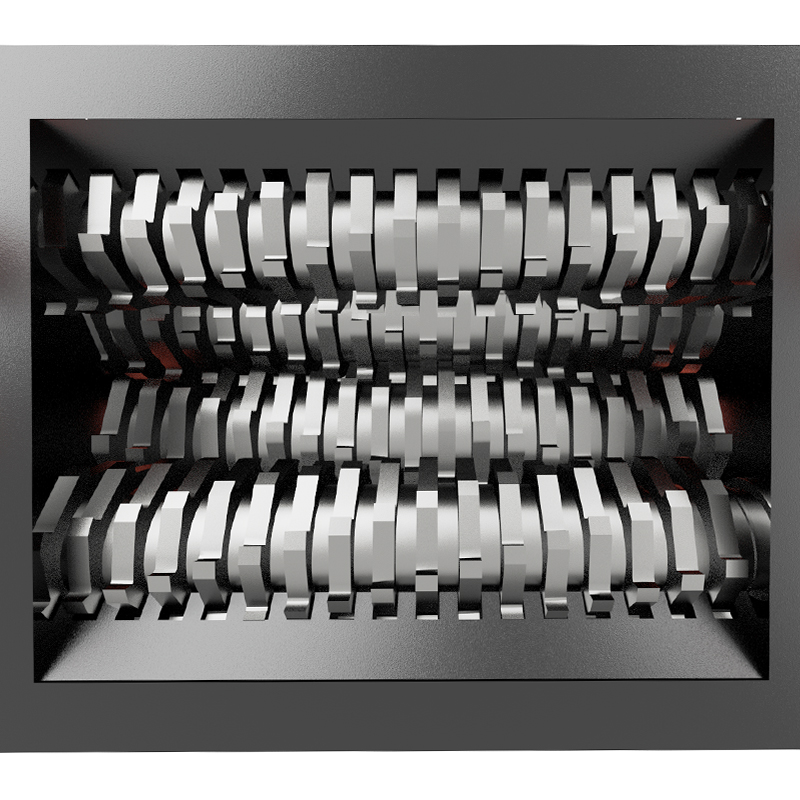
Engineering predictable output requires a fundamentally different mechanical approach. Quad-shaft equipment redesigns the entire cutting chamber to force material compliance.
The mechanics rely on four distinct rotors working in tandem. Two primary cutting shafts sit higher in the chamber to grab and pull the material downward. They perform the initial ripping action. Below them, two secondary sweeping shafts rotate at different speeds. These bottom shafts clear the primary cutters, preventing material wrapping. They then force the shredded pieces down against a rigid sizing screen.
The sizing screen serves as the absolute gatekeeper. If a shredded chunk is larger than the screen's hole diameter, it cannot pass. Instead of jamming the screen, the secondary sweeping shafts catch the oversized piece. They automatically sweep it back upward into the primary cutting zone. This internal recirculation loop repeats continuously until every particle matches the required dimension. You achieve final sizing without relying on any external conveyors or screening decks.
A reliable Four Shaft Shredder operates on a low-speed, high-torque principle. High-speed granulators generate massive dust clouds and carry a severe risk of sparking when they strike hidden metals. Conversely, high-torque shearing minimizes dust generation. It drastically reduces fire risks and operates at a much lower decibel level. This dynamic protects workers and improves overall plant safety while quietly handling incredibly tough materials.
Choosing between these two technologies requires understanding their fundamental differences. Each serves a distinct purpose in the waste processing hierarchy.
Feature | Two-Shaft Shredder | Four-Shaft Shredder |
|---|---|---|
Output Control | Produces variable, random strips. No screen integration. | Delivers fixed, predictable particle sizes dictated by the screen hole diameter. |
Footprint & Redundancy | Often requires a secondary shredder or granulator to achieve the final required size. | Combines primary and secondary shredding capabilities into one single machine footprint. |
Material Suitability | Ideal for sheer volume reduction of Municipal Solid Waste (MSW) or bulky construction debris. | Necessary for WEEE (e-waste), medical waste, confidential documents, and mixed plastics requiring distinct separation. |
If you process raw municipal solid waste destined for a landfill, variable strips present no issue. Two-shaft units dominate here. However, when you extract valuable commodities, you need predictability. Quad-shaft technology removes the guesswork. The screen strictly dictates the maximum particle size. Every piece exiting the machine matches your exact specification.
Plant floor space carries a high premium. A traditional setup requires a primary shredder, a conveyor belt, a trommel screen, and a secondary granulator. This multi-machine line consumes massive square footage. A quad-shaft unit combines primary volume reduction and secondary sizing into one compact footprint. You eliminate intermediate conveyors and streamline the entire process.
Certain waste streams demand quad-shaft processing. Electronic waste (WEEE) contains tightly bound mixtures of plastic, copper, and steel. You must liberate these components uniformly for downstream magnetic and eddy current separators. Medical waste requires uniform shredding to guarantee steam penetration during autoclaving. For these demanding applications, two-shaft units simply fall short.
Procuring heavy recycling equipment requires careful technical evaluation. You must look past the spec sheet and analyze how the machine will behave on your floor.
Screen Accessibility and Changeover: Evaluate how easily your maintenance team can swap sizing screens. Operators frequently change screen sizes to accommodate different product runs. If a screen takes a full shift to change, plant downtime will destroy your ROI. Look for hydraulic screen cradles that drop down quickly for rapid replacement.
Drive System Configuration: Assess the choice between hydraulic and electric drives. Hydraulic drives offer superior shock-load protection. If your material stream contains unpredictable massive metal chunks, hydraulics absorb the sudden impact, protecting the gears. Electric drives, however, provide better energy efficiency. Choose electric if your stream remains consistent and largely predictable.
Cutter Geometry and Material: Examine the rotor design closely. Look for individually replaceable knives instead of solid monoblock rotors. When you process highly abrasive materials, blade edges wear down. Individually bolted knives allow you to replace only the damaged sections. This drastically reduces replacement costs compared to pulling out an entire rotor.
Auto-Reversal Mechanisms: Ensure the internal PLC system includes highly sensitive auto-reverse functionality. Even the most powerful machines jam. A smart PLC detects resistance spikes in milliseconds. It instantly reverses the shafts to clear the jam, then resumes forward motion. This prevents permanent shaft deformation and eliminates motor burnout.
Advanced mechanical capability brings increased complexity. Facility managers must prepare for the realities of running a quad-shaft system daily.
Precision requires parts. Acknowledge immediately that four shafts mean you are managing double the bearings, seals, and blades compared to dual-shaft systems. Preventative maintenance schedules must be rigorous and uncompromising. Your team cannot skip daily inspections. They must monitor bearing lubrication constantly to prevent catastrophic seal failures. The trade-off for perfect output size is a steeper maintenance curve.
Abrasiveness dictates maintenance frequency. Processing glass, fiberglass, or certain e-wastes accelerates wear across the entire cutting chamber. The internal recirculation loop means abrasive chunks hit the blades multiple times. The sizing screen and the sweeping shafts take heavy abuse. Facility managers must stock adequate spare screens and schedule routine hard-facing for the cutters to maintain sharp edges.
You need a realistic view of energy usage. Quad-shaft systems pull significant power. Their peak power draw often exceeds standard dual-shaft machines. However, you must view this holistically. Because you eliminate a secondary shredder and the connecting conveyors, your overall plant energy draw often decreases. The net kilowatt-per-ton ratio frequently favors the single-pass quad-shaft setup.
Modern processing demands precision. Investing in quad-shaft technology makes strategic sense when your operation requires precise output size and single-step processing. These benefits heavily outweigh the higher initial capital expenditure and the more complex maintenance routines.
Never buy heavy machinery blindly. We strongly recommend a material test before signing any purchase orders. Demand a factory trial run. Ship a batch of your specific, toughest waste stream to the manufacturer and watch the machine process it in real-time.
Stop letting unpredictable waste control your plant's throughput. Contact specialized engineering or sales teams today to schedule a facility-specific throughput and sizing consultation. Secure the right equipment to keep your processing lines running flawlessly.
A: Avoid highly elastic materials like massive rubber blocks or very thick textiles, as they can wrap around shafts despite sweeping mechanisms. Additionally, massive solid steel blocks or heavy engine blocks that exceed the machine's sheer strength will cause severe jams and potential structural damage.
A: Yes. Size adjustment happens strictly by swapping the mechanical screen located beneath the shafts. The screen's hole diameter dictates the maximum particle size. You cannot adjust output size through software; it requires a physical hardware change.
A: Lifespan varies wildly based on material abrasiveness. Processing soft plastics allows blades to last over a year. Processing e-waste or glass may require maintenance every few months. Proper tensioning, routine hard-facing, and avoiding uncrushable metals significantly extend blade lifespan.
A: It uniquely functions as both simultaneously. The top shafts perform the rough primary shredding, while the bottom shafts and screen execute the secondary sizing. It effectively bridges the gap between massive volume reduction and fine granulation in one step.


