


 English English
 Views: 0 Author: Site Editor Publish Time: 2026-06-16 Origin: Site


Global ESG mandates and circular economy targets demand rapid action from modern industries. Garment manufacturers and waste management facilities feel this rising pressure daily. Stakeholders now expect sustainable textile recovery over traditional landfilling practices.
However, processing discarded garments creates massive engineering hurdles. Standard industrial shredders frequently fail when they process textiles. They consistently struggle against high tensile strength and aggressive fiber wrapping. These basic machines also trigger thermal melting in modern synthetic fabrics. This ruins the equipment and halts production lines.
You need clear strategies to process garments efficiently. This guide provides an objective framework for your facility. You will learn how to evaluate, shortlist, and implement a commercial unit. We help you choose the right equipment without overcapitalizing. We focus purely on mechanical efficiency, operational reliability, and output precision.
Material dictates the machine: Garments, heavy carpets, and non-woven synthetics require fundamentally different torque and blade geometries.
Rotor wrapping is the primary operational risk: Selecting machines with anti-tangling technology reduces maintenance downtime by up to 40%.
Pre-sorting matters: While robust machines handle zippers and rivets, bulk metal contamination drastically accelerates blade wear.
Standard industrial shredders use blade geometries designed for brittle or rigid materials. Plastics and woods snap under pressure. Textiles behave entirely differently. They resist cutting forces through flexibility and high tensile strength. This fundamental mismatch causes catastrophic equipment failures.
Long fibers stretch heavily before they finally break. Denim threads and carpet backing fibers slip past blunt cutting edges. They then wrap tightly around the main rotor shaft. This wrapping action builds up rapidly over minutes.
The accumulated fabric creates immense friction against the machine housing. This stalls the primary drive motor completely. Maintenance teams must then manually cut these tangled messes away from the rotor. Frequent rotor wrapping destroys operational efficiency and creates unsafe maintenance conditions.
High-speed shredding relies on rapid impacts. These impacts generate intense friction heat inside the cutting chamber. Modern apparel contains high percentages of polyester, nylon, and elastane. These synthetic polymers possess relatively low melting points.
Friction heat melts these synthetic materials during the shredding process. The molten plastic then cools and solidifies around the cutting knives. This forms hard plastic blocks inside the machine. Operators must shut down the line and chisel the solidified plastic out of the chamber.
Unsorted textile waste always contains hidden metal contaminants. Jeans have brass zippers. Jackets feature steel snaps. Mixed industrial waste often hides heavy steel-toe boots. These items enter the shredding chamber unexpectedly.
Standard shredder blades lack the necessary metallurgical hardness. Heavy tramp metal instantly chips non-hardened cutting edges. Damaged blades cannot shear fabric cleanly. They simply chew and fold the material instead. This drastically accelerates equipment wear and degrades your final output quality.
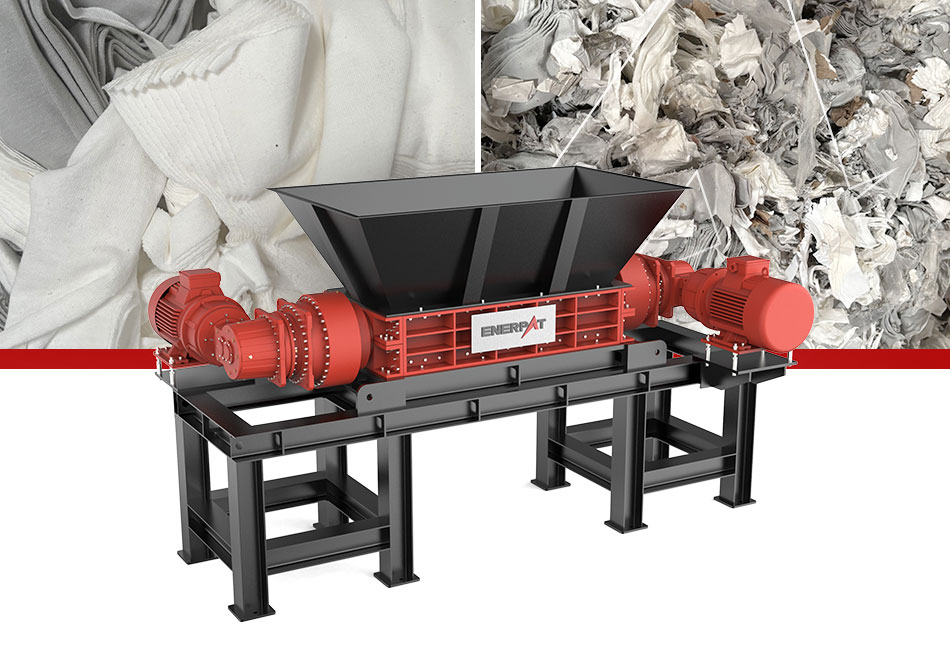
Selecting an effective Fabric Shredding Machine requires matching the technology to your specific material stream. No single machine handles every textile type perfectly. You must understand the underlying mechanical approaches.
These machines excel at uniform size reduction. They produce fine, consistent output particles. Buyers typically use this output for pelletizing or yarn spinning applications.
The mechanism relies on a hydraulic pusher ram. This ram presses textile bales against a high-speed spinning rotor. The rotor holds multiple square cutting inserts. These inserts shear the fabric against stationary bed knives mounted in the housing. A sizing screen sits below the rotor. Material stays in the chamber until it falls through the screen holes. This guarantees a strict maximum particle size.
These units serve best as pre-shredders. They handle bulk clothing bales, heavy carpets, and high-volume raw destruction. They prioritize maximum throughput over precise output sizing.
The mechanism uses two counter-rotating shafts. These shafts spin at very low speeds but deliver immense torque. Interlocking hook blades grab the fabric and pull it downward. The shearing action between the opposing blades tears the material into long strips. They easily process mild tramp metal. However, they cannot guarantee a specific, uniform final particle size.
These specialized machines process clean, continuous rolls of fabric. They also handle targeted off-cuts directly from manufacturing lines. They do not work well for mixed, baled consumer clothing.
They operate using a heavy, dropping blade assembly. The blade slices through thick material layers like a giant pair of scissors. They offer incredible efficiency for uniform industrial scraps.
Machine Type | Primary Use Case | Speed/Torque Profile | Output Consistency |
|---|---|---|---|
Single-Shaft | Fine shredding, pelletizing preparation | High Speed / Medium Torque | High (Screen controlled) |
Dual-Shaft | Pre-shredding, bulk bale breaking | Low Speed / High Torque | Low (Long strips) |
Guillotine Cutter | Clean rolls, continuous manufacturing off-cuts | Variable Stroke / High Impact | Medium (Clean edge cuts) |
Purchasing the correct Textile Shredding Machine demands strict technical evaluation. You cannot rely on generic equipment specifications. Textile recycling requires highly customized engineering solutions.
Standard carbon steel blades fail quickly in textile applications. You require high-alloy, wear-resistant steel for longevity. Look for D2 tool steel or H13 metallurgical grades. Some manufacturers also offer specialized hard-facing treatments for extra durability.
Blade clearance represents a critical factor. The gap between rotating knives and stationary bed knives must remain incredibly tight. Loose clearances allow thin fabrics to fold over the blade. Tight clearances ensure genuine shearing action. You should specify machines offering adjustable bed knives to maintain this minimal gap over time.
Drive system selection dictates energy efficiency and jam-resistance. Each format offers distinct engineering advantages.
Electric Drives: These systems utilize variable frequency drives (VFDs). They offer superior energy efficiency. They work perfectly for continuous, predictable material loads. Clean manufacturing off-cuts suit electric drives best.
Hydraulic Drives: These systems absorb massive shock loads without damaging internal components. They remain essential for unpredictable loads. Baled consumer clothing often contains heavy contaminants. Hydraulic motors generate instant peak torque to crush or shear these obstacles safely.
Single-shaft machines use bottom screens to control output size. Facility needs often change based on downstream buyer requirements. You might need 50mm flakes one week and 20mm fragments the next week.
Evaluate the screen swapping process. Heavy screens often require specialized lifting gear. Premium machines feature drop-down hydraulic screen cradles. These allow a single operator to swap the screen safely in under fifteen minutes.
Jams will inevitably occur during heavy production runs. Operator intervention presents major safety risks. You need autonomous clearing solutions.
Modern equipment features auto-reverse functionality. Programmable logic controllers (PLCs) monitor motor torque continuously. The PLC instantly halts the motor during a torque spike. It reverses the rotor automatically to clear the tangled fabric. It then resumes forward operation. This happens in seconds without human involvement.
Installing a shredder represents only the first step. True operational success requires comprehensive facility integration. You must address safety, material handling, and realistic production expectations.
Textile shredding shears millions of tiny fibers every minute. This creates highly combustible micro-dust. This airborne particulate poses severe respiratory risks. It also creates a massive facility explosion hazard.
You must install a negative-pressure dust extraction system. This pulls airborne fibers out of the cutting chamber constantly. Spark detection systems remain non-negotiable for OSHA and NFPA compliance. A single spark from a shredded zipper can ignite the dust stream instantly. High-speed deluge systems must integrate directly into your ductwork.
You must move the shredded output away from the machine continuously. Gravity drops often fail because shredded fabric bridges and clogs easily.
Pneumatic Conveyors: High-velocity air systems move light fabric flakes efficiently. They prevent bridging and keep the area clean.
Magnetic Cross-Belts: You must install strong over-band magnets on your discharge belts. These pull shredded zippers, buttons, and rivets out of the fabric stream.
Balers & Briquetters: Fluffed textile output consumes massive floor space. Direct integration into an automatic baler compresses the material immediately for transport.
Never take vendor throughput claims at face value. Vendors often calculate "tons per hour" using dense materials like wood or hard plastics. Fabric has incredibly low bulk density.
A machine rated for five tons of plastic might only process one ton of loose clothing. Throughput relies heavily on feeding mechanisms. You need aggressive mechanical grabbers or heavy hydraulic pushers to force the fluffy material into the cutting zone. Always calculate capacity based on the specific volume of uncompressed textiles.
Protect your capital investment through rigorous vendor vetting. An objective testing protocol separates capable manufacturers from poor ones.
Never buy industrial equipment based on paper specifications alone. You must mandate vendor testing. Send them large samples of your specific fabric waste. Include complex blends and high-elasticity materials.
Attend the testing session personally. Watch the machine handle large, unsorted bundles. Measure the exact output size. Monitor the heat levels inside the cutting chamber. A successful PoC provides absolute confidence in the machine's capabilities.
Evaluate the physical machine design strictly for maintenance access. Downtime destroys profitability. Ask specific mechanical questions during your inspection.
How long does it take to rotate the cutting knives? Can operators access the rotor without entering the hopper? Examine the main rotor bearings carefully. The bearings must sit entirely outside the cutting chamber. This isolation prevents invasive micro-fibers from destroying the bearing seals.
Read the warranty documentation carefully. Ensure absolute clarity regarding inclusions. Manufacturers usually exclude "wear parts" from standard warranties. Knives, screens, and bed blocks fall into this category.
Focus on structural guarantees. The rotor shaft, gearbox, and main housing should carry extended coverage. Negotiate clear service level agreements. Demand guaranteed response times for specialized technician dispatches. Verify the vendor holds extensive spare parts inventory locally.
Selecting the optimal equipment hinges on a realistic assessment of your operations. You must understand your input material variety thoroughly. You must also define your strict desired output sizes. Standard equipment simply cannot handle the high tensile strength of modern textiles.
Take these actionable next steps immediately. First, document your exact material stream composition. Note the percentage of synthetics versus natural fibers. Second, define your realistic hourly throughput targets based on fabric density. Finally, audit your facility's power availability and fire suppression capabilities. Complete these assessments before initiating any vendor outreach.
A: No. Paper shredders rely on different tensile assumptions. Fabric will stretch, slip between blades without cutting, and tightly wrap the drive shaft. This causes immediate equipment failure and severe motor strain.
A: Heavy-duty dual-shaft machines can process small tramp metal. However, doing so regularly accelerates blade dulling. Post-shredding magnetic separation is required, and pre-sorting heavy metals is highly recommended for optimal machine performance.
A: Dual-shaft pre-shredders produce 50mm–150mm strips. Single-shaft shredders with precision screens can reduce textiles down to 10mm–20mm. This smaller size proves suitable for chemical recycling or briquetting applications.
A: Opt for high-torque, low-RPM shredding technologies that minimize friction. Some advanced setups use water-cooling systems on the rotor shaft. This prevents heat buildup for highly sensitive synthetic polymers.


